
The Centralization Trap
Why Every System Rots the Same Way - And What Comes Next

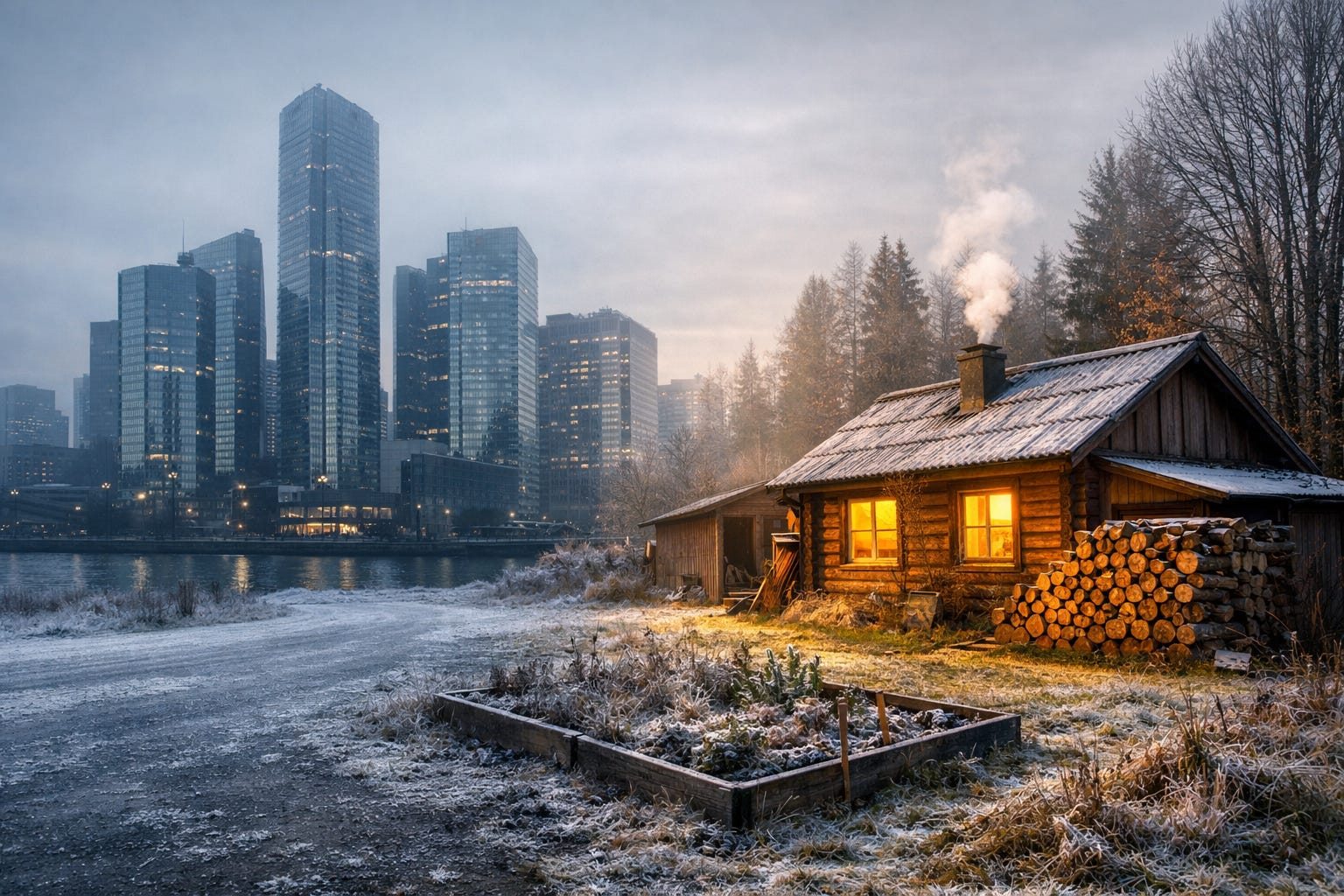
Every January, the same ritual plays out in Davos. The world’s elites gather in the Swiss Alps to decide what’s best for the rest of us. They fly in on private jets to discuss climate change. They stay in luxury hotels to talk about inequality. They speak in carefully crafted language about “stakeholder capitalism” and “sustainable development goals” while the gap between their world and ours grows wider every year.
I watch this theater with a particular kind of nausea. Not because I’m against wealth or success. But because I’ve seen this movie before.
It ends badly.
The Pattern I Can’t Unsee
I was born in Soviet Latvia in 1979. By the time I was old enough to understand the world, I was living inside a system built on a simple promise:
“We know what’s best for you. Trust the plan. Sacrifice now, paradise later.”
The Party elites made all the decisions. They controlled the money, the resources, the information. They lived in a different reality than the rest of us - better apartments, better food, access to things ordinary people could only dream of. And they genuinely believed they were serving the people.
They believed this right up until the system collapsed.
Here’s what I learned in those years, before the Soviet Union fell: When power concentrates, reality warps. The people at the top stop feeling the consequences of their decisions. They surround themselves with others who think like them. They mistake their position for wisdom. And slowly, without even realizing it, they start to believe that the system exists to serve them—not the other way around.
The Soviet Union didn’t collapse because the ideology was wrong in theory. It collapsed because the gap between what the system claimed to be (workers’ paradise) and what it actually was (elite-controlled machine) became unbridgeable.
Now I watch Davos. I watch the World Economic Forum. I watch tech monopolies, financial institutions, and supranational bureaucracies. I watch wealth concentrate in fewer and fewer hands while everyone else is told to be patient, to trust the experts, to follow the plan.
And I see the same psychological structure. Different branding. Same operating system.
Centralization always corrupts reality. Not sometimes. Always.
The Uncomfortable Truth
Yanis Varoufakis calls what we’re living through “technofeudalism” - a system where the new lords aren’t landowners but platform owners, extracting rents from every transaction, every interaction, every moment of our digital lives. David Harvey has been warning for decades that capitalism’s internal logic - perpetual accumulation, endless expansion - inevitably leads to concentration of wealth and power.
They’re describing the same pattern I lived through in the Soviet system: power flows upward, decisions drift away from reality, and ordinary people become subjects instead of citizens.
The difference is the costume. Soviet elites wore grey suits and spoke in Marxist slogans. Today’s elites wear Patagonia vests and speak in the language of innovation and sustainability. But the structure underneath is hauntingly similar:
Decisions made far from the people affected by them
Money created and controlled by distant institutions
Survival dependent on systems you don’t control
Independence punished, compliance rewarded
We rejected Soviet totalitarianism because it failed the human test. It crushed individuality, killed initiative, turned people into cogs in a machine that served the Party, not the people.
But look at what we’re building now. Look honestly.
How many people do you know who are working jobs they hate to pay off debt they were told they needed to take on? How many are trapped in cities they can’t afford because that’s where the “opportunities” are? How many feel like they’re running faster and faster just to stay in place?
The system tells them they’re free. But freedom that depends entirely on participating in a game whose rules you didn’t write and can’t change isn’t freedom. It’s just a prettier cage.
Latvia’s 30-Year Experiment
I want to tell you about Latvia - not because it’s special, but because it’s a perfect laboratory for understanding what happens when you build sovereignty on borrowed power.
When the Soviet Union collapsed in 1991, Latvia had a choice. We were small, traumatized, resource-rich but capital-poor. We needed to rebuild everything: economy, government, identity.
We chose the path that seemed obvious: integrate with the West. Join the EU. Open our markets. Let the money flow in.
And the money did flow in. Scandinavian banks. EU structural funds. Foreign investment. It felt like progress. It felt like we were finally free.
But here’s what actually happened over 30 years:
The money came from outside. Which meant the decisions came from outside. Latvian politicians and bureaucrats didn’t ask “What’s best for Latvia?” They asked “What does Brussels want? What do the banks want? What will get us the next round of funding?”
We inherited the Soviet nervous system and applied it to EU governance. Centralized decision-making. Bureaucratic complexity. Decisions made in distant offices by people who would never feel the consequences.
We became dependent. Not on Moscow this time, but on a different kind of distant power. External money. External validation. External rules.
Let me give you one concrete example: energy.
Latvia is one of the greenest countries in Europe. We have forests. We have biomass. We have hydro. We have low population density and high renewable potential.
And yet: energy is expensive. Households are fragile. People are anxious about heating their homes.
Why?
Because energy policy isn’t designed around Latvia’s physical reality.
It’s designed around EU frameworks, carbon markets, financial instruments, and bureaucratic targets set in Brussels by people who will never spend a Latvian winter wondering if they can afford to turn on the heat.
This isn’t about whether the EU is “good” or “bad.” It’s about a simple, brutal truth:
When money is external, decisions are external. And when decisions are external, sovereignty is impossible.
Latvia isn’t failing. Latvia is showing us - in miniature - what happens everywhere when you build a society on borrowed power instead of local capacity.
The Day I Saw the Machine
I became a Vice President at Swedbank when I was 27 years old. I wore the suit. I had the title. I made the decisions that moved millions through the system.
I was everything I’d been programmed to become: successful, respected, important.
And I was spiritually empty.
But I didn’t understand why until one day in Stockholm, during a business trip.
I was walking through the city with the top executives of Swedbank. We passed building after building in the center of the city, and they kept pointing:
“We own this building. That building. This one too.”
They said it with pride. Like a king surveying his domain.
At the time, I thought: This is what success looks like.
Only years later - after the collapse of the Latvian private mortgage market - did I realize what I’d actually witnessed.
The banks knew all along what would happen.
They would never lose.
Here’s how the game worked: Dump massive amounts of money into the Latvian market. Lend it to people desperate to own homes, to build lives, to finally have something of their own after decades of Soviet deprivation. Drive prices into the sky. Make everyone believe this is normal, this is progress, this is freedom.
And then... when the market burst - and it always bursts - take the assets.
The buildings. The homes. The dreams.
And the people? They stayed in debt. Still paying. Still trapped.
You see, at the time, the financial institutions ruled. The legislation didn’t protect individuals. It protected foreign investors. Because that was the nervous system of the ruling class - much like feudal times - bow before the barons.
This time, the barons were Scandinavian banks.
And they’re not bad people. I worked with them. I know them. They were just working the system for their benefit.
A rigged system.
The realization that broke me open wasn’t about morality in some abstract sense. It was brutally simple:
I was part of a machine designed to extract from ordinary people and concentrate wealth in the hands of those who already had it.
And I was being rewarded for it. Praised for it. Promoted for it.
The money I was moving wasn’t connected to anything real. It was created through debt, moved through speculation, extracted through financial engineering. People were working themselves to exhaustion to pay back loans on houses they couldn’t afford - houses the bank would eventually take anyway.
And when the collapse came, nobody from Stockholm lost their buildings.
They pointed to those buildings with pride because the game was designed so they couldn’t lose.
The mask I’d built - the “successful” version of myself - was exactly that: a mask. Underneath was a question I couldn’t escape:
“Is this what we’re here for? Is this what success is supposed to feel like?”
I left banking. Deconstructed everything. Started over.
And I’ve spent the years since trying to understand: What would it look like to build systems that actually serve human life instead of extraction?
What the Economic Thinkers Are Telling Us
Here’s the part that should scare everyone paying attention: even capitalism’s own architects are sounding the alarm.
Ray Dalio - one of the most successful hedge fund managers in history - has been warning that wealth concentration in 2026 is at levels we haven’t seen since the 1930s. The top 0.1% control as much wealth as the bottom 90% combined. This isn’t sustainable. This isn’t moral. This is a self-reinforcing loop where the rich get richer and everyone else stagnates, and it threatens the entire social fabric.
Kate Raworth offers a different frame entirely with Doughnut Economics. Instead of asking “How do we maximize GDP?” she asks: “How do we ensure everyone has what they need socially while staying within planetary boundaries?” It’s a shift from growth-worship to human wellbeing as the actual measure of success.
Joseph Stiglitz has spent decades showing that markets don’t self-regulate toward justice - they concentrate power unless society refuses to let profit become the only compass. Markets are tools. Powerful tools. But tools in service of what? If the answer is “more wealth for those who already have it,” the system is broken.
Nassim Taleb frames it through fragility and resilience: centralized systems are brittle. When they fail, they fail catastrophically. Decentralized systems are antifragile - they learn, adapt, survive. Skin in the game means consequences are visible. Decisions are grounded in reality.
They’re all pointing at the same rot from different angles:
Centralization of money, power, and decisions breaks the feedback loop between action and consequence. And when that loop breaks, systems serve themselves instead of the people inside them.
The Core Philosophy: Business as Practical Spirituality
Let me be clear about what I mean by “Business as Practical Spirituality.”
I’m not talking about meditation apps or corporate mindfulness programs or putting Buddha quotes in the break room.
I’m talking about a fundamental reorientation:
Systems should serve human flourishing, not the other way around.
That sounds simple. It’s not.
Because right now, we’ve built a world where humans exist to serve systems. You work to pay the debt. You comply to keep the job. You optimize yourself to fit the market. You measure your worth in productivity.
And we call this freedom.
Here’s what a human-centered system actually looks like:
Layer 1: Survival Sovereignty
Food. Shelter. Energy. Safety.
These aren’t abstractions. These are the foundation of human dignity.
If people can’t meet these needs locally - if they depend entirely on global supply chains, distant utilities, external financing - they’re not citizens. They’re subjects.
Real sovereignty means:
Food produced locally, owned locally, governed locally
Shelter people can actually afford without debt slavery
Energy generated close to where it’s used (especially absurd in places like Latvia with abundant renewable resources)
Safety rooted in real community connection, not dependence on distant institutions
This isn’t romanticism. This is nervous system economics. When people don’t feel existentially safe, they become manipulable, anxious, and controllable.
Layer 2: Distributed Ownership
Not “you’ll own nothing and be happy” (the nightmare vision some elites are selling).
But real ownership. Land. Homes. Businesses. Productive capacity.
Because ownership = responsibility = adult citizenship.
When everything is rented, leased, subscribed to, or controlled by distant institutions, you’re not building a life. You’re a tenant in someone else’s system.
Layer 3: Productive Money
Money should be a claim on real production, not a speculative asset conjured by central banks and lent at interest by private institutions.
I’m talking about:
Money earned through work, not created from nothing
Money that circulates locally, building local resilience
Money as a tool for exchange, not a mechanism for extraction
This is the hardest layer to shift because monetary systems are the most captured, the most centralized, the most protected by power.
But debt-based money is a form of control. When you owe, you comply. When entire nations owe, sovereignty becomes theater.
Layer 4: Decentralized Governance
Decisions should be made as close to the ground as possible.
Subsidiarity: solve problems at the lowest effective level.
Because here’s the brutal truth: human systems become psychopathic at scale.
Not because people are bad. But because:
Feedback loops disappear
Responsibility diffuses
Power becomes abstract
Consequences become invisible
Small systems force reality checks. You see the people affected by your decisions. You live with the outcomes.
Big systems produce ideology, narratives, and distance instead.
This is why big corporations rot. Why big states ossify. Why big institutions drift into self-preservation mode.
The shift: From KPIs (productivity, efficiency, growth) to human wellbeing as the actual measure of whether a system is working.
If your economic model is succeeding but people are anxious, exhausted, disconnected, and medicated just to function - your model is broken.
The Paradox We’re Living In
Here’s the uncomfortable truth almost no one wants to say out loud:
We’ve solved the survival problem. But we’re still trapped in survival mode.
Humanity - at least in the developed world - has enough food. Enough shelter. Enough resources. The basics of physical survival are technically handled.
But our nervous systems haven’t caught up.
We’re still running the program:
“Push through. Survive. No pain, no gain. Work harder. Produce more. Never stop.”
This made sense when survival actually WAS the issue. When we were escaping poverty, rebuilding after wars, industrializing to meet basic needs.
It doesn’t make sense anymore.
But we can’t stop. Because we don’t know what comes next.
The elites benefit from keeping us here - in chronic survival mode. Anxious people are controllable. Distracted people don’t ask difficult questions. Exhausted people don’t organize, don’t resist, don’t imagine alternatives.
So we keep grinding. We keep optimizing. We keep measuring our worth in productivity metrics that have nothing to do with whether we’re actually living.
The real challenge now - the one that Business as Practical Spirituality is pointing toward - is this:
Can we shift from “How do we survive?” to “What do we want to CREATE?”
Not just produce. Not just consume. But live. Connect. Flourish.
This requires something radical: securing the survival basics AND decentralizing them.
Local food. Local shelter. Local energy.
Not because we’re anti-technology or anti-trade, but because when survival is handled and distributed, humans are free to ask deeper questions.
Questions like:
Who are we as beings, not just workers?
What kind of life do we actually want?
What’s worth building?
These aren’t luxury questions. They’re the questions we’ve been too afraid - or too busy surviving - to ask.
AI: The New Fork in the Road
There’s another layer to this that we can’t ignore: we’re standing at a technological inflection point that mirrors industrialization.
Industrialization gave us productivity, abundance, and progress. It also gave us: exploitation, alienation, environmental challenges, and the embedding of survival-mode thinking even after survival was solved.
We took a powerful tool and used it to build systems that served extraction and accumulation instead of human flourishing.
AI is the same choice, at an even larger scale.
It has the potential to either:
A) Centralize power even further - Tech monopolies (or governments?) controlling infrastructure. Surveillance normalized. Humans increasingly dependent and, in many domains, obsolete. The cage gets tighter, smarter, harder to see.
B) Decentralize and liberate — Automate repetitive work. Free humans from tasks that drain us. Give people time and energy back to reconnect, create, and live. Distribute access instead of concentrating it.
The outcome depends entirely on the operating system we’re running.
If we keep the current program - centralization, survival fear, extraction, growth-at-all-costs - AI will amplify all of it. We’ll build a world where a tiny number of people control unimaginable power and everyone else is managed, optimized, and made redundant.
If we shift the operating system - decentralization, human flourishing, distributed ownership, local sovereignty - AI could help us finally break free from the survival treadmill.
But we have to make that choice consciously. Now.
Because once the infrastructure is built, once the power is concentrated, once the systems are locked in - it’s too late.
This is the moment.
The Real Challenge: Changing How We Think
The way forward isn’t a policy paper. It’s not a five-step plan.
It’s a fundamental shift in how we see ourselves and the systems around us.
Right now, most of us have been programmed - by education, by media, by the relentless pressure of the market - to believe we are production machines.
Our worth is measured by output. Our value determined by efficiency. Our success defined by how well we perform the role assigned to us.
We survive. But we don’t live.
And the cage is invisible because we’ve been taught: “There is no alternative.”
But here’s the truth: the cage is a story. And stories can be rewritten.
The way out requires three simultaneous shifts:
1. Change Minds - Deprogram the Inherited Beliefs
We have to see the programs we’re running: the fear, the scarcity thinking, the belief that our worth is tied to what we produce.
We have to ask:
Who am I as a human being, not just a worker or consumer?
This isn’t soft. This is foundational. Because if you don’t know who you are, someone else will define you. And their definition will serve them, not you.
2. Change Systems - Decentralize Power, Money, Decisions
Stop building everything at scale. Stop centralizing everything in distant institutions.
Build local capacity. Real ownership. Distributed governance.
Make survival basics - food, shelter, energy - local and resilient so people aren’t one supply chain disruption away from crisis.
Shift from debt-based money systems that extract to productive money systems that circulate and build.
This is hard. It requires rejecting the convenience of dependence. It requires responsibility.
3. Change Outcomes - From Extraction to Flourishing
Measure what actually matters: Are people healthy? Connected? Able to build lives they want to live?
Not: Are we hitting growth targets? Is productivity up? Are shareholders happy?
If the system is “succeeding” but the humans inside it are breaking—the system is broken.
The Map Forward: What We Can Actually Do
This isn’t utopia. This is survival. This is dignity. This is what humans have always done when systems fail them: build from the ground up.
Here’s the map:
Step 1: Recognize the Pattern
Centralization = corruption. Always. Not because people are evil, but because power without consequences warps reality.
See it in government. See it in corporations. See it in finance. See it in your own life.
Where are you dependent on distant systems you don’t control?
Step 2: Reclaim Local Sovereignty
Start with the basics:
Where does your food come from? Can your community feed itself if supply chains break?
Where does your energy come from? Can you generate it locally?
Where does your money come from? Are you building wealth or just servicing debt?
This isn’t about going off-grid or becoming a prepper. It’s about resilience at human scale.
Step 3: Educate for Humanity
Teach people - kids, adults, everyone - not just skills for the market, but who we are as human beings.
What does it mean to live well? To connect? To create? To flourish?
Because if all we teach is “how to be productive,” we’re just training the next generation of cogs.
Step 4: Build at Human Scale
Family. Neighborhood. Region.
Not abstractions. Not global frameworks. Places where you know people’s names and see the consequences of decisions.
This is where real governance happens. Where real connection happens. Where reality can’t be abstracted away.
Step 5: Choose Leaders Who Serve, Not Manage
Stop electing people who want to manage your life from above.
Choose people who understand subsidiarity. Who trust humans to solve their own problems. Who see their role as enabling, not controlling.
The honest truth: This is hard. It requires adult humans willing to take responsibility instead of waiting to be saved.
Most people are terrified of that. Not because they’re weak, but because we’ve been systematically trained to be dependent.
But the alternative?
Keep running the same centralized script - more debt, more surveillance, more control, more anxiety - until the system collapses under its own contradictions.
We’ve seen that movie. It doesn’t end well.
Latvia’s Choice = Our Choice
Latvia is small. Caught between empires. Historically traumatized. Easy to overlook.
But that’s exactly why it matters.
Because every small place - every region, every community, every family - faces the same choice:
Keep depending on distant power and hope it doesn’t fail you.
Or build from the ground up, even though it’s harder.
Latvia spent 30 years trying the first option. And it left us with expensive energy despite abundant resources, bureaucratic complexity despite being a small nation, and decisions made in Brussels for people living in Riga.
But the same choice exists everywhere:
Will you keep outsourcing your survival, your sovereignty, your decisions to systems that don’t know you and don’t feel the consequences?
Or will you start building - however imperfectly, however slowly - the capacity to take care of yourself and the people around you?
The Invitation
I’m not offering you a perfect system. Perfect systems don’t exist. They’re the fantasy of people who want to control you.
I’m offering you a different operating system:
One where humans come first. Where systems serve life, not the other way around. Where survival basics are secured and decentralized so we’re free to ask what comes next.
Where we stop worshiping growth and start measuring what actually matters: Can people live? Can they flourish? Can they build lives worth living?
This is Business as Practical Spirituality.
Not a theory. A practice. A way of seeing. A way of building.
It starts in your own life. Your own relationships. Your own community.
Because the micro is the macro.
How you run your household is how you’ll run your business. How you treat the person closest to you is how you’ll lead your team. How you think about your own survival is how you’ll think about everyone else’s.
You can’t fix the world from the top down. You never could.
But you can build something real, something grounded, something human - right where you are.
And if enough of us do that, the centralized systems will become irrelevant.
Not because we fought them.
But because we outgrew them.
The window is closing. Centralization accelerates until it collapses.
But if we choose differently - if we decentralize, educate, reconnect - we can build something worth living in.
The question is: Are we ready to stop surviving and start living?
Thank you for reading my Substack. If you feel that it makes sense for us to connect and to see how we can cooperate, let’s talk. 👇